

This is the second in my series of interviews with people who I've been following this year who are engaged in discovery and curation. Sari Azout is the founder of Sublime, an app that lets you save and connect things you find online, and discover related ideas. As you know, I’ve been obsessed this year with digital gardens, how we explore, and how we share our journeys — and Sublime is such an interesting take on that.
For readers who don’t know you yet, can you introduce yourself and talk a bit about what you’re building with Sublime and The Sublime newsletter?
It's taken me a lifetime to get here, but Sublime is where all of my deeply held beliefs coalesce into one piece of software.
There are two sides to Sublime. The first is the more practical one: anyone looking to do great work or think great thoughts must cultivate a repository of interesting ideas, a quiet space to think. And in that sense, Sublime is the result of a decade of looking for the perfect tool to collect and connect ideas. I wanted something easy to use, without a steep learning curve or excessive customisation. Something that would let me capture anything from anywhere and show it to me in a way that makes sense. Something purpose-built to curate my knowledge library without doubling as a to-do list, project management tool, that kind of thing. Something that felt equal parts personal and communal. This last part's key—we are combining the focus and intentionality of a personal knowledge management tool with the serendipity and aliveness of a social space. When you add a thought, link, or idea to Sublime, we immediately show you related ideas from your library and others. It's sublime.
The second is the cultural frame. We think of our mission not as building software, but as equipping people with the tools, spirit, ideas, and community to navigate the digital age with more clarity and conviction. Both the software and the newsletter are marbled with our company’s values:
Each of these values has depth. For example, both are true. Sublime is less about categorising things into a polarising good or bad but rather about looking for answers in the grey and asking: “Does this spark a new part of my mental map that I should pay more attention to?”
Or take creativity over productivity. I believe the productivity mindset that we've optimised for over the last few decades won't serve us in the future. As more human jobs become automated or replaced by artificial intelligence, we have to shift our focus to areas where we have a competitive advantage over machines: creativity, taste, expressing old things in new ways, infusing ideas with meaning. Sublime is designed to help you cultivate a state of flow conducive to this way of being. Humans aren’t good at making things from scratch. For us to truly create and contribute to the world, we have to connect countless dots, cross-pollinate ideas from a wealth of places, and combine and recombine these to build new things.
When you think about Sublime, do you see it more as a tool, a community, or a kind of digital “place”?
For a long time I struggled because I didn’t have a good answer to this. We’ve been so conditioned to place things into neat categories. Sure, Sublime is part bookmarking, part note-taking, part social network. But it’s also none of those things. It’s a little bit of this and a little bit of that. I wrote about this struggle in our 2023 end-of-year letter and you can almost feel my struggle with words when you peruse this unexplainable collection.
The nice thing about where we are today is Sublime is no longer an idea in my head. It’s a thriving product and community. I no longer doubt myself or try to water things down for mass adoption. I’m just building what I’d want for myself and trusting that slowly but surely the others will understand. The others will come.
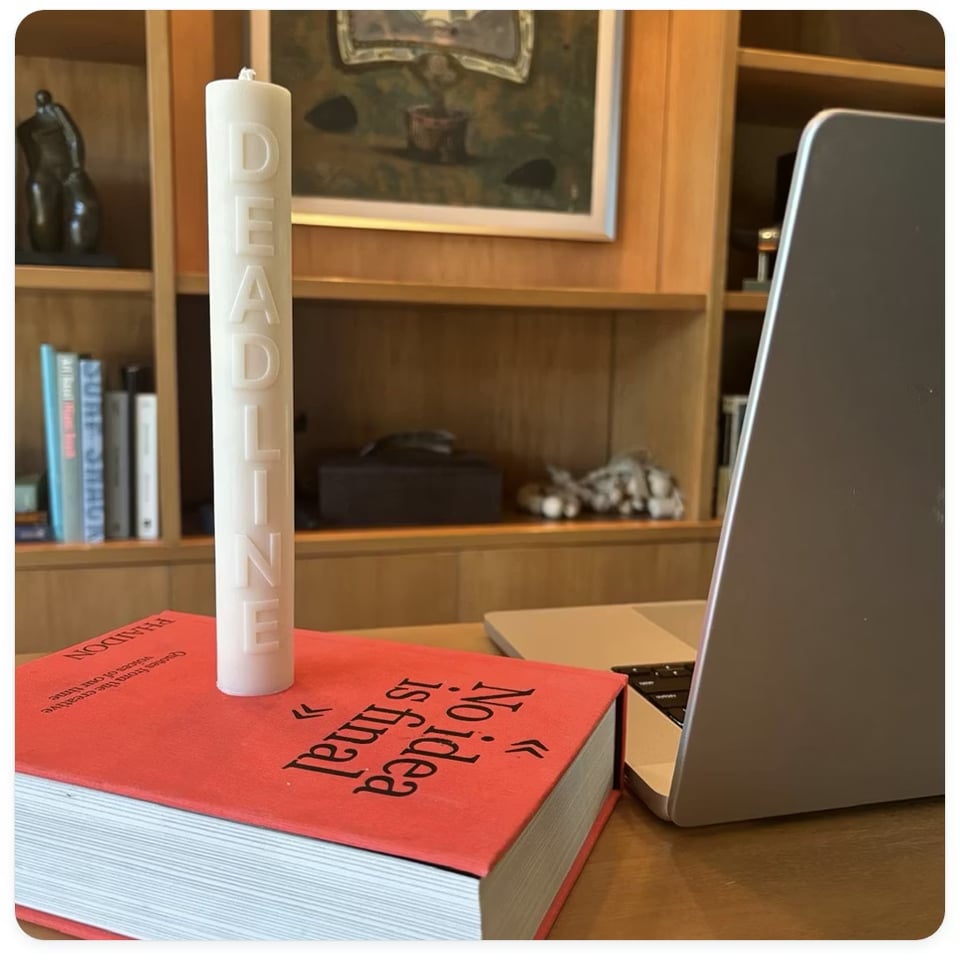
Ultimately, we are driven by feeling, not a checklist of features. We want the internet to feel more sublime. We want people to create more, to feel their most creative. To make something that only they could make. We want people to reclaim that sense of awe, wonder, meaning, and connection in a world made dull by digital automation. And we aim to transmit this feeling in everything we do – our zines, our merch drops (the deadline candle!), our newsletter, our software, and our IRL events.
I often use the metaphor of online “neighbourhoods” rather than “echo chambers”: places we choose to spend time because of the vibe, not because everyone thinks the same. How do you think about neighbourhood-building in your own work — inside Sublime, and around your newsletter?
I love using place metaphors to describe software architecture. Microsoft Word is the quiet room at the university library; personal Gmail is a dirty kitchen, yesterday’s plates stacked next to the sink; Twitter is an overcrowded bar; Instagram is a glossy condo development of brands.
For Sublime, I love the coffee shop analogy. My favourite places are mom & pop cafes where there is a sense of life vs. institutional heaviness. For me these places are the perfect balance of focus, creation, serendipity, solitude, community. These are spaces where insights and creativity come through more easily. This is the vibe we’re trying to cultivate.
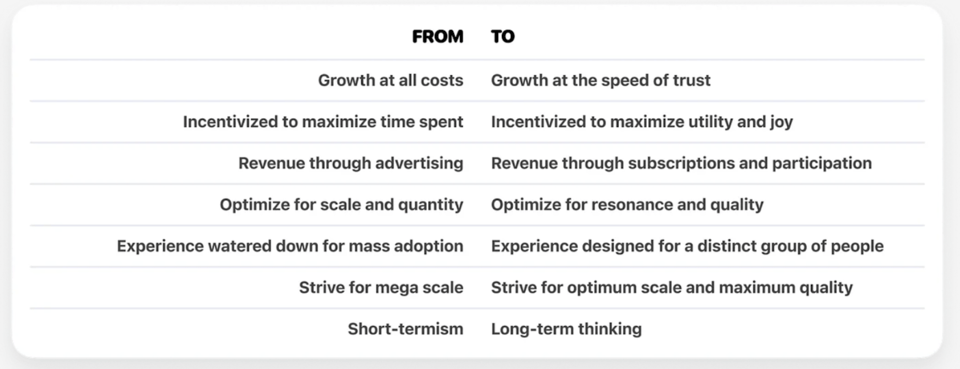
Right now, giant, ad-based networks created by six men that everyone begrudgingly uses with diminishing emotional returns, control the vast majority of the web. The web hasn’t had its artisanal moment and I think places like Sublime present an alternative. This is how I’ve laid it out in the past:
I’m writing a lot about the “post-search” internet – how we can’t really go wandering with Google anymore because it’s so dominated by AI slop. And how we’re back to following human curators because discovery is hard. How do you think about that shift? What have we gained and what have we lost as discovery moves from search boxes to people?
I wrote an article a few years ago in the pre-LLM era called the future of search is boutique and I still stand by what I said. Sublime is a natural extension of that thesis. I think of Sublime as a community and human search engine – trust is extended to unknown members of the community based on the network’s shared values, enabling people to discover and search for more interesting data sources than what we are now getting from Google and LLMs. Now of course Sublime is not a horizontal search engine for everything – it’s more of an inspiration engine for ideas, concepts, etc…
I think it will be harder for a single organisation to search over everything like we were used to in the past with Google. What we’ll see is a bunch of different types of tools that each individually search over their categories. And this will happen more and more because the open web has been replaced by walled gardens, newsletters, private forums, & algorithmic feeds that are never exposed to search. The visible parts of the web that Google still indexes have been overrun by seo-optimised sludge, ai-generated spam, & paywalls.
I still think LLMs are an amazing feat of technology. It’s really cool to be able to say “Hey I’m in Paris in this location and I want a place that sells desserts. I particularly love souffles and want a mom-and-pop vibe not a tourist trap” and get a response. So for queries like that, or more fact-based things it’s much better than the 10 blue links. But for a lot of queries (the more nuanced, abstract stuff we deal with at Sublime), AI answer engines provide quick answers but reduce the joy of unexpected discovery inherent in traditional web browsing. These tools often lack transparent attribution and can obscure how information is sourced and ranked, creating a black box effect. The homogenisation of AI-generated content leads to less creative, more consensus-driven responses, dulling diverse viewpoints.
We have traded the rich, unpredictable discovery of traditional browsing for curated, homogenised answers that limit user control and dilute the web's unique diversity. Sublime presents an alternative – a human curated search and discovery engine for interestingness.
How do you discover new ideas, links, and people now? Do you still find things “in the wild”, or is it mostly through trusted humans, newsletters, and communities? Who are your curators right now?
I don’t have a set process. I find things in lots of places - social media, newsletters, conversations. I’m always on the nose hunting for interestingness. There is a lot of noise on social media but I have also discovered and met incredible people through it. So I try not to complain about it and instead develop the agency to use it to my advantage.
I love Marty at Poolsuite. I love and discover great things on Sublime of course. I like Dot Dot Dot. I love Yancey Strickler and the community at Metalabel. I stay on top of Daisy Alioto. I read most of Kyle Chayka’s stuff. I love Henrik Karlsson’s substack. I do tend to gravitate towards people that don’t have the pressure to post consistently - for example Brie Wolfson doesn’t write often but when she does I love her work.
These days though I am not interested in keeping up with new things. I am more drawn to old obscure PDFs. Writing that has stood the test of time. My preferred way to deal with information overload is to get rid of the assumption that I have to stay on top of anything. I set my goals instead - the topics, themes, projects, ideas I’m embarking on - then let that intention dictate the rabbit holes and information sources I pursue in that moment.
Where do you personally draw the line between “useful algorithm” and “I only want humans in this loop”? Are there places where you’ve found algorithms genuinely helpful for discovery, and others where you feel they actively get in the way?
That kind of word-of-mouth and the kind of discoveries that only happen when a friend shares a recommendation are sacred and will never go away.
But the reality is that as any human network scales, it is inevitable that you need a way to sort & rank content. And the moment you introduce some sort of ranking, you’re introducing an algorithm. Algorithms are just opinions embedded in software.
The problem isn’t algorithms per se, it’s what they’re optimising for. Web 2.0 solved discovery by optimizing for popularity, recency, and time-spent. Those incentives inevitably drift toward ragebait, sensationalism, and lowest-common-denominator content.
I actually think there’s room for a different kind of algorithmic assist that doesn’t try to maximise minutes spent, but maximises depth, creativity, and connection. In Sublime, we use algorithms to expand what a human already cares about, not to redirect their attention toward whatever performs best in the feed. We set a minimal quality threshold (e.g., it appears in multiple libraries) but we don’t try to crown a “winner” or rank everything from most to least important. That leaves more air for serendipity.
So my line is this: I want humans to set the intention and taste to choose what matters. And I want algorithms to quietly support that intention, not overrule it. Algorithms can be an extension of your curiosity, not a replacement for it.
When you zoom out, what gives you hope about the next phase of internet culture and tools? If Sublime “works” in the way you dream about, what changes in how people think, create, or connect online?
For all the hand-wringing about the state of the internet, I think it’s an amazing time to be alive. We all have agency. We can build things. The world is hungry for new things. I don’t know, I choose not to complain. I read someone recently that said: Complaining about internet discourse is the new “you're not stuck in traffic you are traffic”. So that’s where I stand. Be the thing you wish existed. Present alternatives.
Sublime is one such small but opinionated alternative built on a different set of values: creativity, nuance, depth, serendipity, and the joy of slowing down and making something wonderful. It’s already changed the way tens of thousands of people think, create, and connect online. They are creating more, doomscrolling less. They are building a relationship with their own curiosity again.
It’s only been two years… I’m very hopeful that as long as we don’t betray our values and sensibilities, Sublime will become a very meaningful part of a lot of people’s digital lives in the decades ahead.
--
Next time, I’m talking with Caitlin Dewey from Links I would Gchat you if we were friends.
Forward this email to someone with taste.
You just read issue #52 of what you love matters. You can also browse the full archives of this newsletter.


Add a comment: