

Happy New Harry Album Day! Kiss All The Time, Disco Occasionally has dropped. No hot takes until I’ve spent three to five days listening to it on repeat.
Yesterday, I listened to Harry’s interview with Zane Lowe. This long-form interview is something Harry does as part of every album cycle. Lowe has been dubbed “pop’s unofficial therapist” since being hired by Apple Music, specialising in empathetic deep dives into not only an artist’s album, but also their creative process. But yesterday, I was struck again by the fact that after listening to the pair of them talk for an hour, I’d learned absolutely nothing.
It’s a bit of running joke in Harry’s fandom that he’s so media-trained you will never learn anything about him, even in the steady spotlight of promoting a new album. Even here, where Lowe asks about Liam Payne’s death for the first time, all we learn is that losing his friend has caused him to want to “live life to the fullest”. Okay, hallmark card.
What’s interesting to me about this is that Lowe’s interview gives the illusion of access. It’s billed as being raw and unfiltered and an insider view. But it’s actually none of those things.
The ability to seem open while remaining closed is one of the great arts of modern celebrity, and Harry is arguably its best practitioner. He has been doing it since he was sixteen, when the entire thrust of One Direction's fanbase was towards trying to figure out what Harry Styles is actually like. He has never told us. He has, however, spent fifteen years convincingly performing the act of telling us.
Vanity Fair’s February issue was dedicated to the “new late night”, profiling the podcast hosts and influencers that now make up the key stops on a celebrity’s promotional tour.
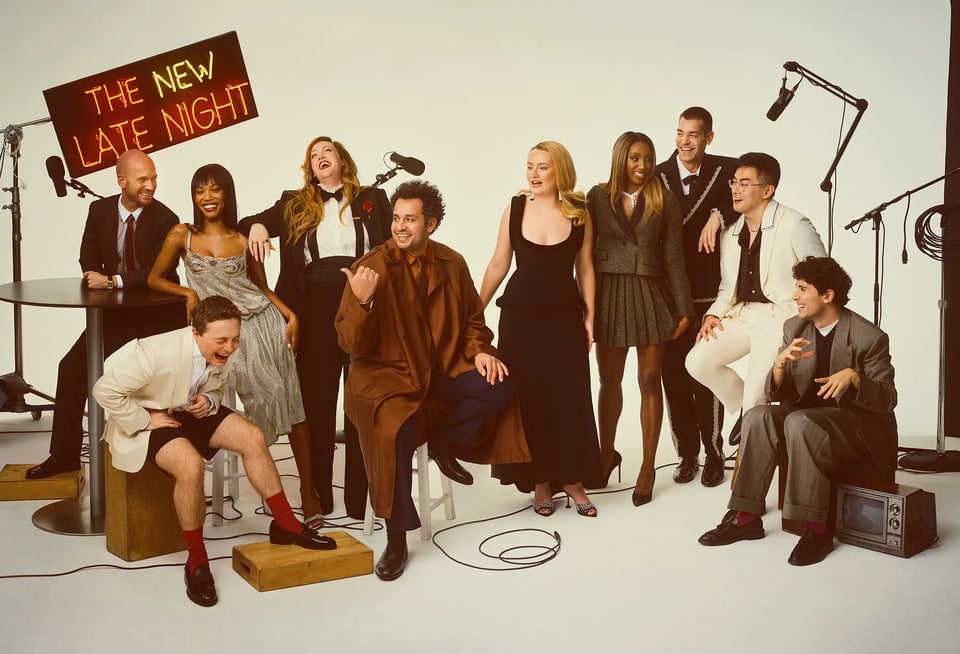
The draw of these interviews is that seem more real than the traditional appearance on Graham Norton’s red couch. “New late-night hosts are not smooth professionals but stand-ins for the viewer: an awkward, enthusiastic fan rubbing up against a celebrity caught in the raw.” (gross sentence, VF, omg)
The dominant narrative about shows like Hot Ones and Chicken Shop Date is that they “broke” the celebrity interview. Late night was polished, rehearsed, controlled — the host feeding you a question you'd already agreed to answer. These new formats are different. They're scrappy. They're free to watch on YouTube. Sean Evans has said explicitly that the original intention behind Hot Ones was "to disrupt the PR-driven flight pattern that so often celebrity guests naturally have when they're doing a press tour." The conceit is that spicy food or weaponised awkwardness or medieval cosplay breaks the training and forces something real.
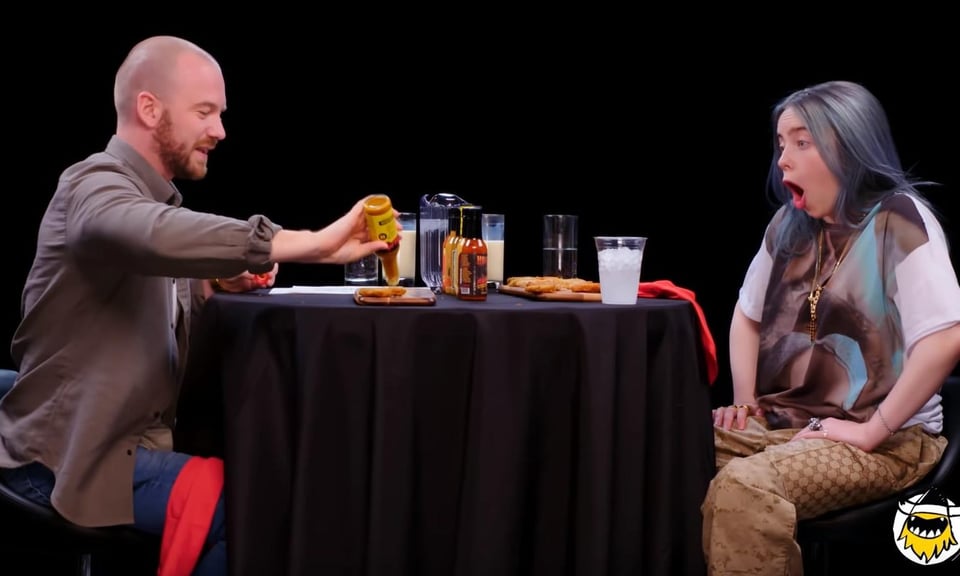
And to be fair, the genuinely interesting thing about Hot Ones, at least, is that Evans is actually a superb researcher — the questions are often the most specific, best-sourced questions a celebrity has heard in years, which produces moments of apparent genuine surprise. But celebrities have learned these new formats just as thoroughly as they learned late night. It is a scheduled part of the promotional apparatus. The format might signal I am not doing this the old way, but the content remains I am not telling you anything I haven't decided to tell you. To be fair to Harry, his appearance on Royal Court did lead me to learn he likes to eat a lot of yoghurt. A quality new fact.
This whole phenomenon was highlighted with Hudson Williams and Connor Storrie’s promo tour for Heated Rivalry, which was described by fans and the press as “unhinged” and “chaotic”. It gave the appearance of two young, unknown actors apparently saying whatever came into their heads.
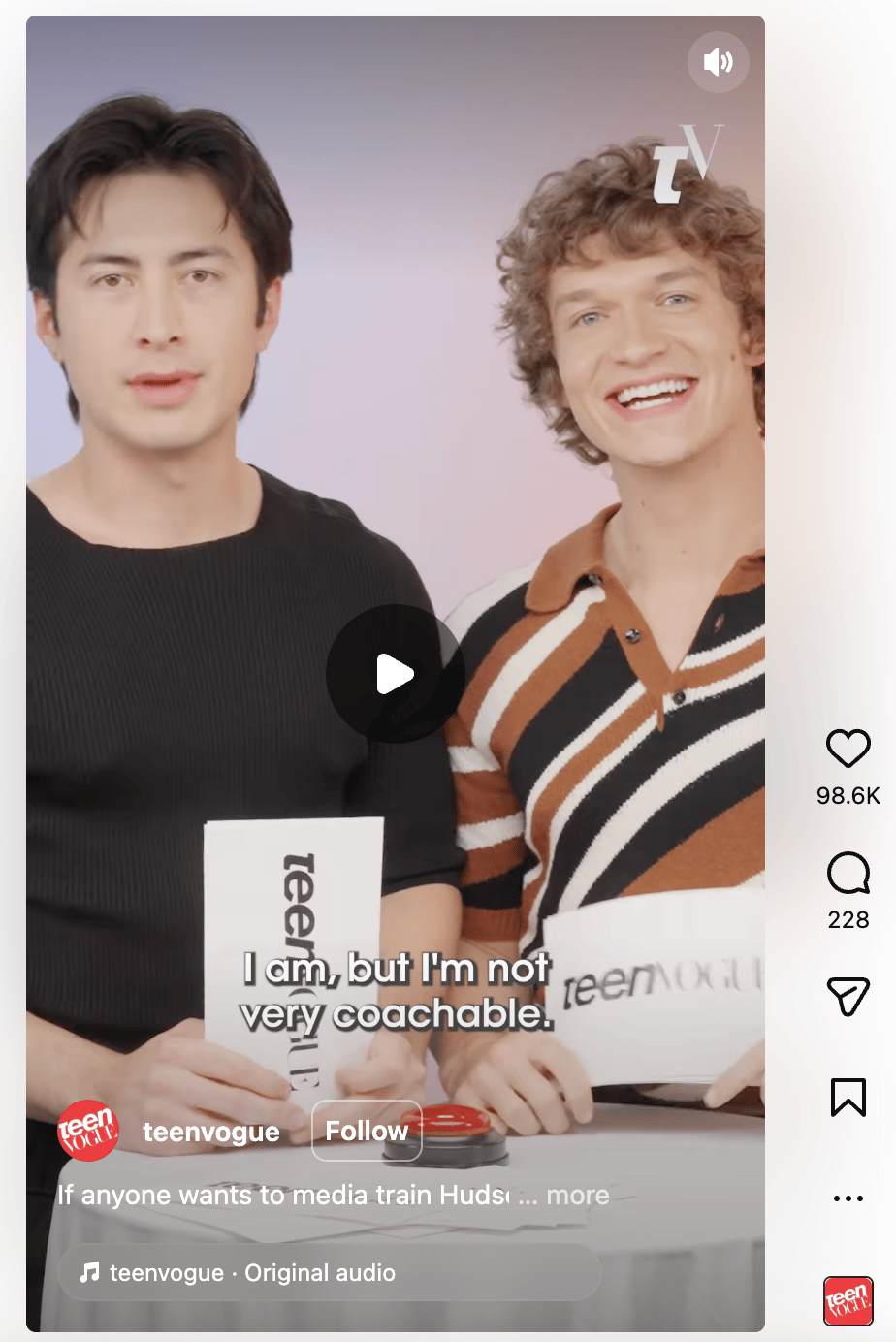
Williams in particular has become a phenomenon: reading thirst tweets with the equanimity of someone doing the morning news, making jokes at the Golden Globes that, by his account, made his team start smoking, and delighting interviewers across the board. He's been framed as an anti-celebrity: untrained, unfiltered, the real thing.
But crucially Connor Storrie and Hudson Williams have actually not told us anything about their personal lives, their sexualities, or their relationships. Williams has said directly: "It's 2025, so let's just keep that private." They've found a way to seem completely unguarded while being carefully protective about the things that matter to them. The apparent wildness and the actual privacy coexist, because the first one is really just another performance.
The Lady Gaga/Bradley Cooper A Star Is Born press tour is, in retrospect, the foundational text for a lot of what we see now on the promo circuit. Actors aren’t just selling a movie or a tv series, they’re selling their “chemistry”. Gaga eventually explained it with more clarity than most: "Yes, people saw love — guess what, that's what we wanted you to see." She told Oprah they "did a really good job at fooling everyone... we created that." The Oscars performance of "Shallow" — the one that broke the internet, the one that had everyone convinced they were in love — was, Cooper later explained, choreographed in deliberate detail.
Since then Glen Powell and Sydney Sweeney rolled out the same playbook for Anyone But You. The internet devoured the pathological closeness Cynthia Erivo and Ariana Grande paraded while promoting Wicked. Now we have Margot Robbie and Jacob Elordi on the Wuthering Heights run.
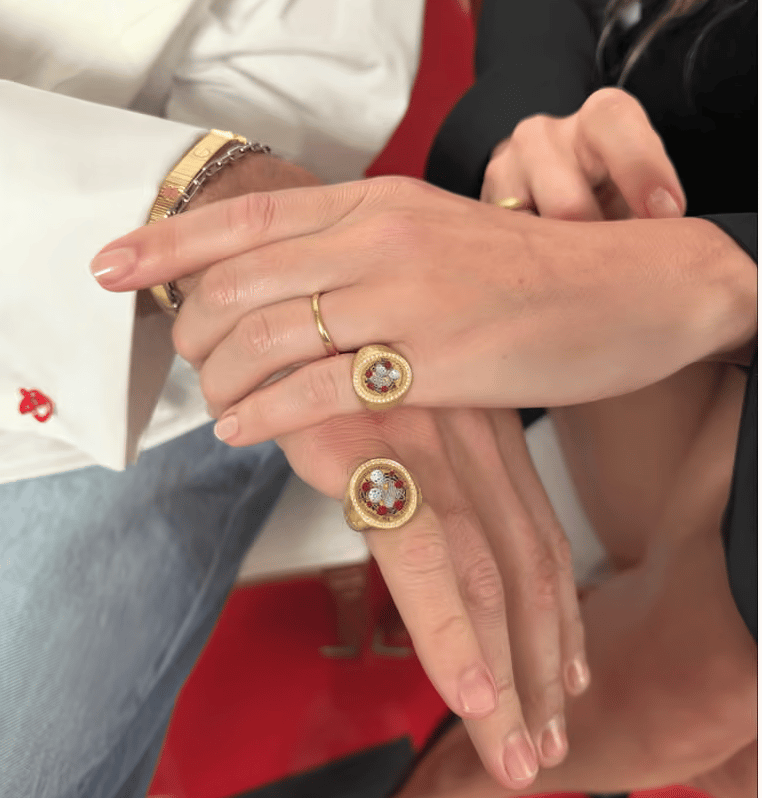
The promotional approach has been to collapse the distance between the fiction and the promotion entirely. Robbie gifted Elordi custom matching rings engraved with a Brontë quote. She described becoming "codependent" on him on set, feeling "lost like a kid without their blanket" when he wasn't nearby. Elordi described a "mutual obsession." Shrines. Lingering looks. The language of Heathcliff and Cathy applied, systematically, to two real people who are not Heathcliff and Cathy. Sources close to the production have since characterised the strategy as deliberate from the outset — a "coordinated publicity push". Robbie's husband, Tom Ackerley, is also an executive producer on the film.
The press tour is no longer promotional material for the work. It's a parallel product, with its own genre conventions, its own stars (the "unhinged" actor, the soulmate co-stars, the therapist-interviewer), its own audience expectations, and its own carefully managed emotional beats. The film or the album is almost beside the point. The press tour is the show. And behind each of these performances is a person who has made a very deliberate decision about what you are and are not allowed to know about them.
But the strategy has a failure mode, and audiences are increasingly fluent in it. The same online attention that makes a press tour chemistry moment go viral can just as quickly identify it as manufactured and quickly catch the ick. Gigi Paris going on a podcast to say she didn't want to be made a fool of gave the Sweeney/Powell narrative a human cost that reframed everything. The Erivo/Grande tour, for a significant portion of the audience, tipped from charming into grating. The Robbie/Elordi rings are a gift to the cynics (like me). The illusion of access depends on the audience consenting to the illusion. And audiences, trained by years of this, are getting better at withdrawing that consent — or at feigning exhaustion, anyway, before clicking on the next one.
Harry's new album is about pleasure and presence and living in the moment — or at least, that's what the press tour has told us it's about. Whether the music tells us anything more than that is, as always with Harry, something we're going to have to figure out for ourselves. He won't be helping.
I'm going to spend the next few days listening. I'll let you know what I think.
more good stuff
over the years as I’ve talked about the spread of misinformation and the costs of abandoning trust & safety teams and human moderation, people often push back by saying the problem is too hard at scale. This is yet another study showing that’s not the case, finding just 100 users were responsible for almost 70 per cent of online conspiracy posts in Canada.
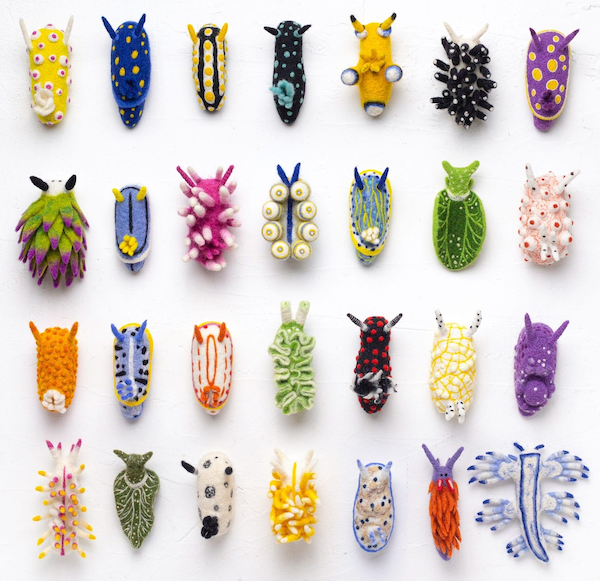
Make sure you click through and see all of the detail on these incredible felted nudibranches from artist Arina Borevich.
another fantastic interview with Rudy Fraser, founder of Blacksky, “on open networks & protocols as the foundation of community sovereignty - including his thoughts on collective intelligence, State surveillance & violence, the legacy of Black anarchism in America, the relationship between values and technical architecture, the role of capital in revolution & more.”
finally, in my lego city

forward this email to someone who needs to listen to KATTDO
You just read issue #64 of what you love matters. You can also browse the full archives of this newsletter.


Add a comment: