

There’s an episode of Parks and Rec where Ron and Chris have a burger cook-off. Chris has banned red meat from the commissary as part of a health initiative, and steak-loving Ron challenges him to put one of his fancy turkey burgers up against Ron’s classic beef mince on a bun.
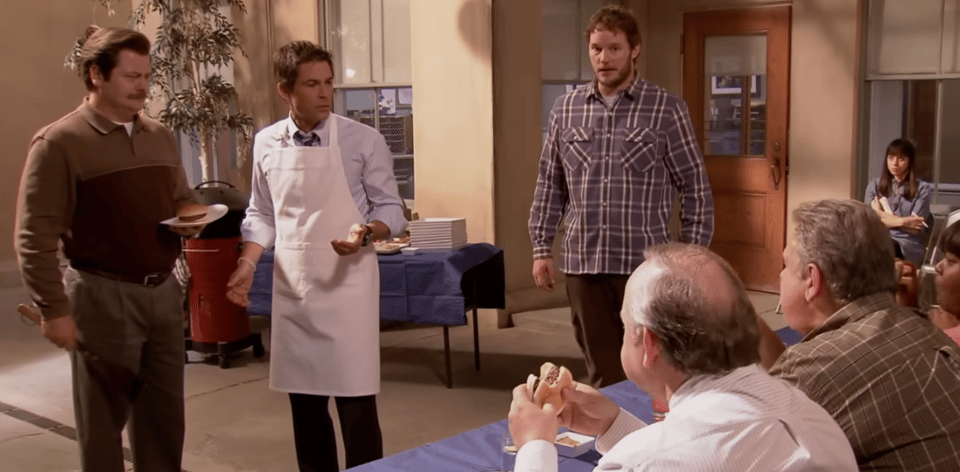
A film school grad, Andrew Rea, was watching the episode and thinking, what would they taste like? So he made both burgers, filmed it for youtube, and launched long-running series Binging with Babish (aside: I only learned while writing this that the channel was named after Oliver Babish, White House counsel on The West Wing. I love a fandom crossover) He’s made the ratatouille from Ratatouille and the Krabby Patty from Sponge Bob. And he does it with a freakish level of detail:
Instead of playing up his personality in a bid to win subscribers, Rea devotes his time and energy to creating content with a high attention to detail and painstaking historical accuracy — both of which require a significant amount of research.
To recreate the strudel from "Inglourious Basterds," for example, the vlogger turned to old Austrian recipes. Rea told INSIDER: "I thought to myself, 'How would they make this in France?' I asked myself, 'Did they have butter?' The answer was no. This movie took place during World War II, and butter was hard to come by."
I was thinking about this last week when I was writing about Hannibal. One of the things that’s so striking about that show is the elaborate meals (a centrepiece for obvious narrative reasons). Janice Poon, the food stylist for the show became a minor celebrity within a fandom whose self-made merch was always branded “eat the rude”.
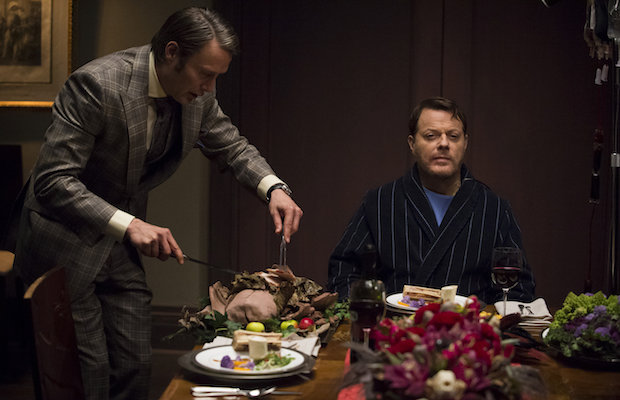
She eventually came out with a cookbook, something that the fans themselves had suggested to her. The desire that Fannibals had to recreate something you’d seen on screen resonated with her:
There were some pink chocolate mice in one of the Noddy books and I spent half my childhood trying to recreate those pink candy mice. And that’s sort of what I’m going for. The interest surprises me in a way, but it speaks to me in another way. I know what that means, it makes it more real.
You love the story so much you could eat it! And being able to reproduce something in a story that you love just brings it that much closer to you, makes it that much more real. I think that’s what our stories are for us in culture, they’re wishes we dream might come true one day or antidotes to our real life.
What they were asking for was also pretty strange. Every dinner Hannibal serves is a lie, and Poon's food was designed to lie in layers. When Hannibal announces he's serving lamb tongue, the audience knows it's a person's tongue, so it has to look a bit like both, while actually being some molded polenta thing the actors can eat through dozens of takes. She calls it a "triple-layered deception." Fans cooking from Feeding Hannibal are faithfully recreating a fake of a fake of a fake.
You probably know cartoonist Alison Bechdel from the Bechdel Test. The joke first appeared in a late nineties comic strip called Dykes to Watch Out For. The strip, a series about lesbians navigating the world, often satirised political thinking about food.
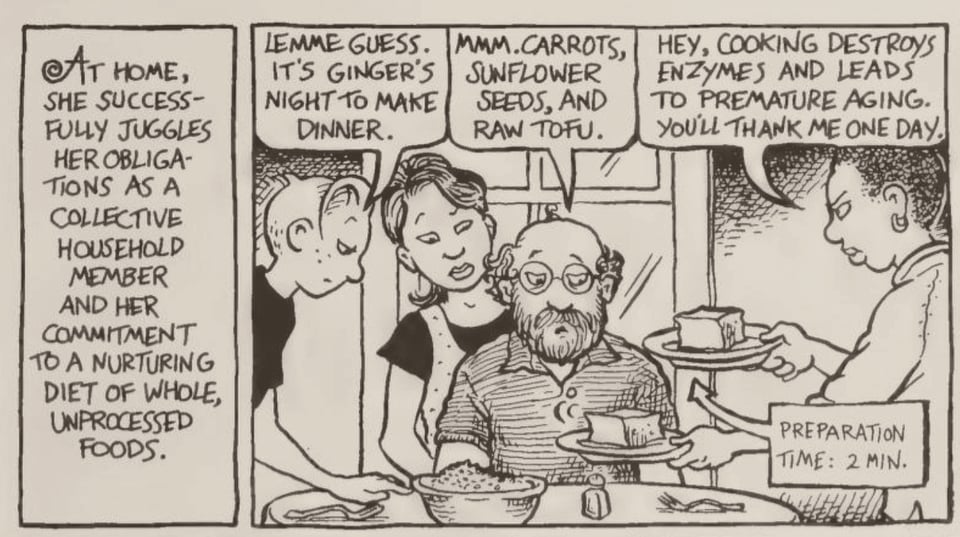
This year for Aftermath’s “woke week”, Riley MacLeod set out to try and recreate the comic’s punchline meals. He abandoned the "wheat-free, dairy-free pizza with no tomatoes" after getting stuck on whether cauliflower crust was a little too modern for 1990. He wouldn't crisp his steamed french fries in the oven because it felt against the spirit of the joke. And for Sydney's osso bucco, he biked over the Manhattan Bridge to a vegan grocery in Chinatown, found a vegan steak that would have been perfect, and turned it down because that kind of fake meat wouldn't have existed when Sydney was making the meal.
These are dishes that were never meant to exist. They're jokes, sendups of self-serious 90s lesbian cooking, but MacLeod held himself to canon compliance anyway. That's the instinct of every fic writer who's ever researched the song that was at the top of the charts in 2005 or the opening hours of a real cafe (once I even tried to work out whether Tesco reusable shopping bags existed in the timeframe I was writing). The joke deserves a faithful recreation, even (especially) when the faithful recreation is steamed celery.
Netflix's Bon Appetit, Your Majesty, is a show about a French chef who time-travels into the Joseon dynasty and cooks for a tyrant king.

The show (and others like it) has put Korean palace cuisine in front of a global audience.
“Korean palace cuisine, as the name implies, is the food that kings and queens and the people of the palace ate in the Korean palace,” he said on a Zoom call in early October. “Korean palace cuisine is itself a subset of Korean cuisine, but has its own set of dishes and recipes. But more importantly, I think it’s a culture. And the reason I say that is because, just like in the ‘Bon Appetit, Your Majesty’ show, they used food, not just to eat, but often as a ritualistic event. They were trying to send a message.”
Part of the reason palace cuisine is not familiar, even to Korean foodies, is historical gatekeeping: the palace maintained a "no leaving the door" policy, so the only way to learn or taste the food was to be inside. In 2011, UNESCO declined to recognise it as intangible cultural heritage because there was no evidence of community participation. Master cooks and fine-dining chefs were preserving it, but nobody was cooking it at home.
So Junwon Park, who’s training to become a Korean craftsman-level cook, started posting recipes on instagram and asked the audience the dramas had built to cook them and upload proof. A viewer in Guatemala made janggukjuk, a beef and mushroom porridge. People messaged him through translation apps from across the Middle East and Africa. "A culture is not what a politician, or a CEO, or a pop star says it is," Park says. "It is what we make happen in our homes."
Wildly, the palace cuisine being revived is itself a reconstruction. Court traditions largely vanished after Japanese colonial rule began in 1910, and royal cuisine only received official attention again in the 1970s, rebuilt partly from the palace's obsessive records of what was served at which banquet. It's a canon pieced back together from primary sources and kept alive by fans.
Eat the thing you love.
more good stuff
new from bestie Mike, How to Dance Through the Apocalypse. Get yourself a boombox.
the new season of Taskmaster NZ is really good. Get it on TVNZ or your youtube if you don’t live in Aotearoa.
god i love completionist fans. This, via webcurios, is a collection of 3D models of every object you could roll up in Katamari Damacy. why would anyone make this? I don’t know and I love it.
finally, in my lego city

Forward this email to someone who cooks.
You just read issue #93 of what you love matters. You can also browse the full archives of this newsletter.


Add a comment: