

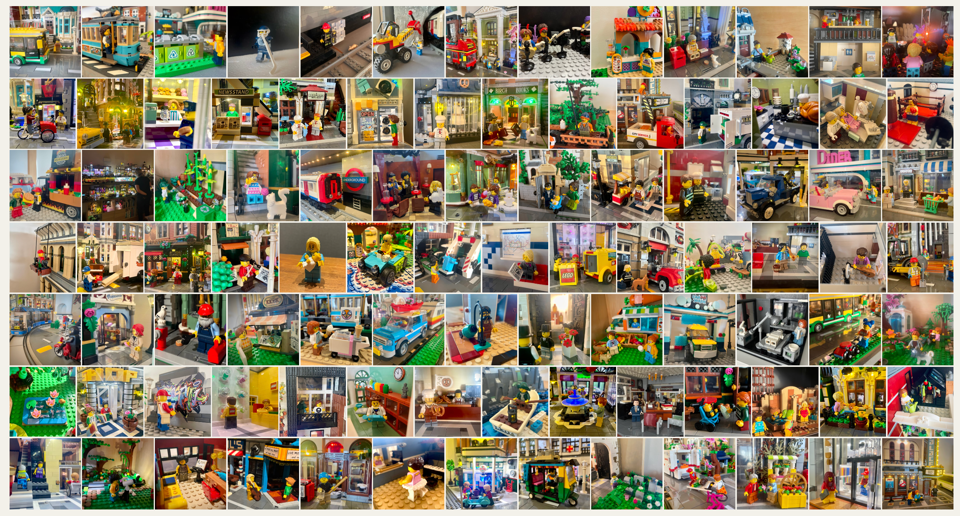
Ok, so when I go to find a picture from my lego city to finish each of these newsletters, I forget what I’ve already shared and I have to keep a running note of it so you don’t get the same picture of a lego Harry Styles every few weeks. And in that note, I use the issue number, which is literally the only reason I know that this is the 100th issue of this newsy.
This seems insane to me. The first post was in March ‘24 and I was just missing old twitter and wanting a place to share what I’d written or spoken about recently, the way I would have posted in ye olde days. I promised I wasn’t starting a newsletter. Well, here we are. Sorry about that.
Anyway, no navel gazing. I thought for the 100th, I’d just pick five things I’ve written about that are still currently swirling through the headlines. Everything old is new again, or something.
the mouse house
Last May I wrote about Disney Adults, the people Rolling Stone called the “most hated group on the internet” (lol, as if), and how the backlash was the usual business of calling things women love cringe. This month The Cut announced that Disney Adults are over and Disney Cool Girls have arrived. Disney fans who don’t want to be associated with the cringe, and who think their thrifted, “understated” looks somehow set them apart from the usual fans. Katrina at Fangirl Forward has the best take on it: the cool girl is fandom’s “not like other girls”. You get out from under the stereotype by agreeing that it’s fair about everyone else, but not about you.
I think what I find myself questioning is the impulse to make those comparisons in the first place. There's a difference between saying you prefer vintage Disney fashion over Loungefly bags and making a point of telling people you're not the kind of Disney adult who carries one. One describes your personal taste, while the other uses someone else's perfectly harmless enthusiasm to establish what makes yours more acceptable. You can genuinely engage with a fandom differently without needing to position yourself against the people who don't engage with it the same way.
That’s the hierarchy of cool inside a single fandom, and it’s bleak. I get it, we all want to distinguish ourselves from the obsessives who we think make us look cray. But we don’t need to. Wear the ears.
carded at the op shop
In ID, please in October last year, I said that if the internet was a nightclub, we’d all soon be queuing at the door fumbling for our wallets. Now it seems like the queue is going to get longer.
The UK’s under-16 social media ban is due in March, and the Culture Secretary is now looking at adding eBay, Vinted and Depop, because they have messaging features that could, in theory, permit grooming or allow teens to circumvent the bans on other sites. The Guardian reports that up to 150 platforms could be covered, possibly including LegoPlay (rude) and Spotify. “Social media” now means anything with a message button, so a fourteen-year-old may soon need to prove her age to sell a jumper. We need to be so, so wary of each of these encroachments. As I wrote about in a bouncer in your pocket, each one makes showing ID to do something online a little more ordinary and we should be absolutely railing against that. Meanwhile, teen mental health is actually improving back to pre-pandemic levels. The kids are, if not actually alright, getting a lot better.
With teen mental health, it’s not just suicide and suicidality that are showing positive signs. Researchers often focus on those numbers because they are among the easiest to measure, but they are far from comprehensive. The Substance Abuse and Mental Health Services Administration report also shows a remarkably positive trend for teens reporting a major depressive episode in the last year, which fell 27.4 percent between 2021 and 2025. A more serious category of depression, major depressive episode with severe impairment, fell by roughly the same amount in that period. The number of adolescents reporting both a major depressive episode and substance use disorder fell further, with the agency reporting almost a 40 percent drop over just four years. And though the report began asking about anxiety only in 2024, those numbers fell in 2025, too — with the share of adolescents reporting a severe form of the disorder falling by almost 10 percent in a single year. According to the Youth Risk Behavior Survey, the share of teens reporting persistent sadness and hopelessness, which held relatively steady in the decades leading up to the pandemic, is now back down closer to previous levels.
still not neutral
In April this year I wrote about Andy Weir, John Lithgow and the fantasy of neutral entertainment. And I was clear then (and since) that with JK Rowling there’s no separating the art from the artist, because the art funds the campaign of hate she continues to wage on trans rights.
But here we are. The new HBO version of Harry Potter lands on Christmas Day, the character posters dropped this week, and the promo machine is warming up to make all of this inescapable even if you’re trying quite hard. Mo Ryan has this week written a great piece called “What do we do with the new Harry Potter show?” . She calls the show “the Sun City of TV”, after the South African resort that artists kept playing through the cultural boycott of apartheid.
Musicians trotted out any number of excuses: Artistic freedom; audiences weren’t only composed of white people; the artists deserved to earn a living; creative folks couldn’t get mired in the issues affecting each country they played; art builds bridges, etc.
Of all the excuses offered, the most tedious one was an artist saying they were “not political.” Please. Everything’s political. Ed Sheeran and a lot of other people nowadays want that not to be true, but it is true. If you use a rubric I once heard — “politics is how you treat people” — it’s normal to see a lot of life as political.
We all make choices that result in ourselves or others being treated well or treated badly, and some of our choices send messages to the world.
I said last time that the neutral space always exists at someone else’s expense. That goes for the recap, the cast interview and the ten-things-you-missed-in-the-trailer post as well. Don’t do it.
girl u should join a union
When I wrote about Katseye and pop as labour, the trainees were fracturing feet and having hip surgery for a shot at debuting, and I asked how much of yourself you can give before there’s nothing left to sell.
Katseye rocketed to stardom, but there’s something super grim about the way it’s unfolding. They are currently a six-piece touring arenas with four members: Manon has been “on hiatus” since February and Sophia since August. Then Megan got a concussion and three shows were postponed, at which point the remaining three asked to go on as a trio. When the tour resumed in Austin she performed seated, in dark glasses, and was back on her feet doing the choreography the next night. Fans who’d been annoyed about the cancelled dates switched to begging her to go home and rest. I hate everything about this. Hybe workers: please unionise.
just build something
The oldest argument in this newsletter is the good internet: the idea that the open web is still there if we want to go build for it.
Paul Ford has written something this week that I find really interesting on this. He built an office suite that stores its data in the URL. It’s called Tiny Little Office and it’s lovely. His point in the write-up is that browsers are stuffed with serious machinery (3D graphics, audio, cryptography) that was built for teams at Google, and the cost of using it has collapsed for everyone else. Ford wonders what happens to the app store tax when you can test an idea from a web server for more or less no cost. As you know, I’m very in favour of a hundred times as many people making small, weird software for each other, on the web. With that in mind, listen to Hank Green interview Neal Agarwal, who makes all the cool stuff at neal.fun, which I link to all the time.
I didn’t intend to write to you a hundred times or for these hundred things to add up to a single thing. In that good internet piece I said that sharing our favourite things is a love language, and that I didn’t need an audience any bigger than you and whoever you forward this to and that’s still the whole plan. See you next week for #101.
more good stuff
luce let me write to the SYSCAhood yesterday about finding new music as we launch Lume into Australia.
So if it’s your job to try and convince fans to listen to the band or the artist you’re promoting, then you’re going to engage in all the tactics you can. I know that astroturfing has been around forever. If you were an OG Directioner (hi Luce!) you’ll recall how often people claimed either that fans were industry plants, or that street teams had “insider access”, or that stalkers were getting perks. Most of the time this wasn’t true, but we all know that the music industry does all it can to get fans hyped for a new star – it’s just that now it’s harder and harder to tell what’s real fan behaviour and what’s just another scam.
it seems apt while reminiscing about old twitter to share this fantastic animation (starring Chris O’Dowd and Aisling Bea) that brings to life the incredibly viral twitter thread about an inattentive student who gets his days confused and ends up alone with the President of Ireland whilst high on ketamine.
please go see You Can See Everything, and do it as spoiler-free as you possibly can. Once you have, I really enjoyed this conversation between Ophie Dokie and Kat Tenbarge about it.
finally, in my lego city
see! they have all been different!
Forward this email to anyone at all, but not if they use Outlook.
You just read issue #100 of what you love matters. You can also browse the full archives of this newsletter.


Add a comment: