

A couple of years ago, bestie Rob and I went to see Tom Hiddleston in the West End in Betrayal. Afterwards we went backstage to say hi, Rob insisting on embarrassing me by suggesting that Hiddleston watch my ten-minute guide to all the Avengers movies as if he hadn’t starred in them. When we left, security showed us out through the stage door, where we encountered a staggeringly long line of fans who were very disappointed that we weren’t who they were waiting for.
I was thinking about that when I read this Guardian story last year about fans queuing for the stage door to see Hiddleston (and others). The author talks to tourists who’ve bought tickets for multiple nights of a show just in case. One person in the queue left the play halfway through to make sure they got a good spot.
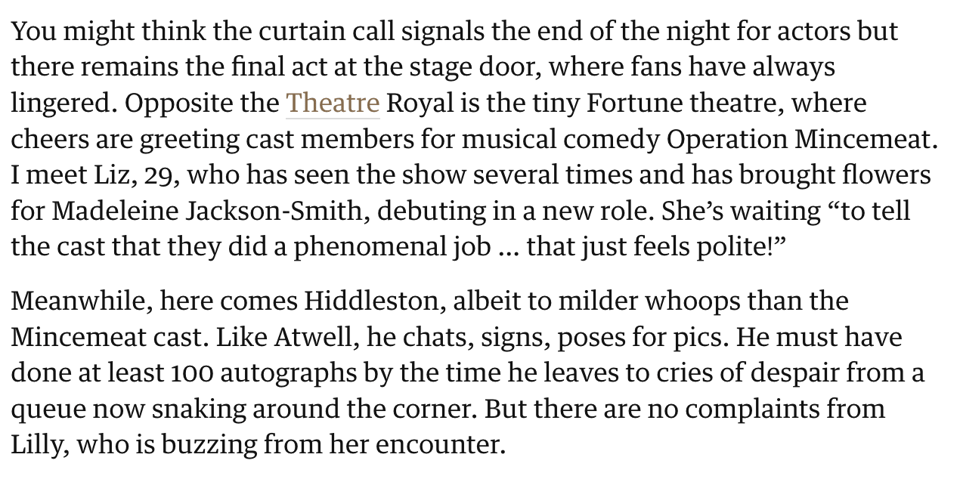
For me, the idea of standing on line in the cold for the possibility that a star will come out and sign my programme is pretty unappealing. Even worse than camping on line for barricade. But I love that we’re all different types of fans, and stage door is maybe one of the last truly free fan interactions left, in an era where everything costs more and more.
But reading that Guardian piece again this week, it gets more fraught. For every heartwarming story of a terminally-ill fan getting their dreams fulfilled, there’s an exhausting side to the unpaid work the star is doing. That thirty seconds of attention, multiplied by 125 people, is an hour at the end of an eight-show week. The security provision is unpredictable — sometimes a dedicated guard, sometimes nobody. Actors describe being grabbed, followed to where they’re staying, strangled by an over-enthusiastic hug from behind. Paul Mescal had to tell a fan to take her hand off his arse. And this doesn't just happen to the A-listers with security details; it happens to ensemble members on minimum wage, who walk out of the stage door onto a dark street and, as Zoe Birkett (the actress who was playing Tina Turner in the stage musical) puts it, “hope people are going to be nice”.
I was thinking about that this week as I followed the Club Chalamet mess in Paris. Kat Tenbarge writes about it brilliantly here. The tl;dr is that fans waiting outside actor Connor Storrie’s hotel for signatures got into an altercation. Tenbarge writes about how algorithmic platforms have taken the kind of intra-fandom friction that used to stay locked away on tumblr and broadcast it to millions of onlookers, all invited to pass judgment on which middle-aged woman deserves to stand outside a hotel. There's misogyny running in every direction here — fans policing each other, the internet mocking all of them, and the actual question of anyone's safety (Storrie's included) getting lost in the discourse.
[An aside: why do people do this? You’re thrilled? Okay, why are you quote posting this if you’re above it all?]
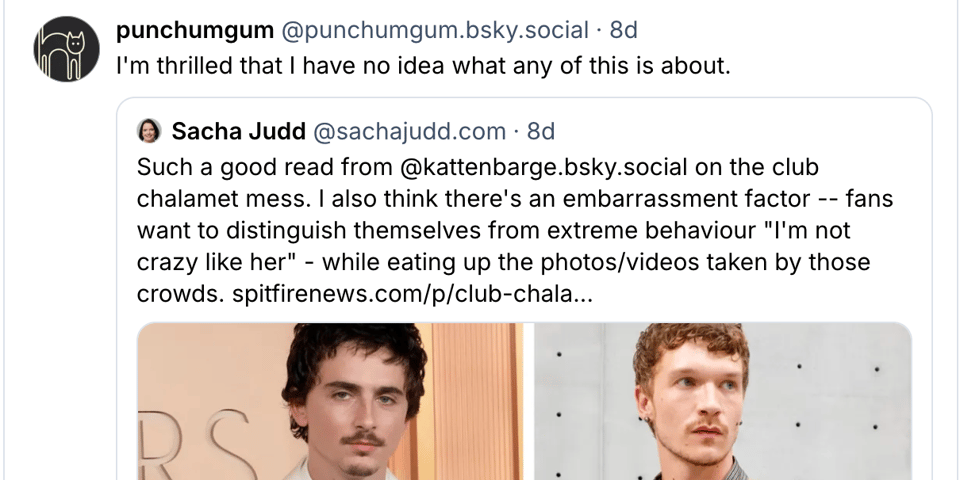
I keep thinking about how much of this fight is really about scarcity. When access is unstructured, it becomes a competition. Who found the hotel first. Who's a "real" fan and who's a tourist. Who's behaving appropriately and who's embarrassing the fandom.
Miranda Larsen dubbed this sort of behaviour “affective hoarding”:
I found the many interactions with K-pop idols were structured around the potential for affect, including handshake events, taking selfies together, and autograph sessions. More than just a tangible object, each of these interactions was ‘charged’ with potential for connection and intimacy. Rookie idols based in the neighborhood of Shin-Okubo offer even more potential than their major counterparts: for example, fans are welcome to give them gifts (anything you can think of including jewelry and alcohol). Additional affectively charged moments are available by accompanying the idols on PR, having them record private videos on one’s cell phone, or even having a recorded 5 Minute Date together. All of these instances were further intensified with transcultural connections.
In these spaces I found some fans practiced “affective hoarding” — that is, monopolizing chances for affect or affectively charged physical objects with a conscious aim to lessen the experience of other fans. Essentially, while someone’s status (subcultural capital) might increase because of their affective hoarding, the main motivation for their hoarding is to keep an experience away from someone else in the first place.
A couple of years ago I worked the Supanova fan conventions in Australia with bestie Adam.
At these conventions, fans pay for a signing, or a professional photo. You join a managed queue. There are staff and barriers and a schedule. The guest knows exactly how many interactions they're doing, for how long, and they're being paid for every one of them.
At first I thought this was bizarre and slightly exploitative. But weirdly, the transaction makes the whole thing warmer, not colder. Nobody's anxious about whether they're allowed to be there. They’re not competing for scraps of attention, because attention has been portioned out fairly. The guest isn't managing a crowd alone; there are handlers and minders and a table between them and the queue, which means they can actually be totally present for the person in front of them. It's a big part of why Adam does cons at all: the structure carries the load that goodwill alone would otherwise have to, so he can spend his energy on the fans rather than on crowd control. I watched people walk away from a minute or two with him genuinely glowing, and I watched Adam stay happy and generous through hundreds of them in a day, because the format made that possible.
The obvious catch is the price tag. When a photo op costs what a photo op costs, proximity becomes another thing you buy, and plenty of fans are priced out entirely — the same dynamic we saw with VIP packages and the ticket wars.
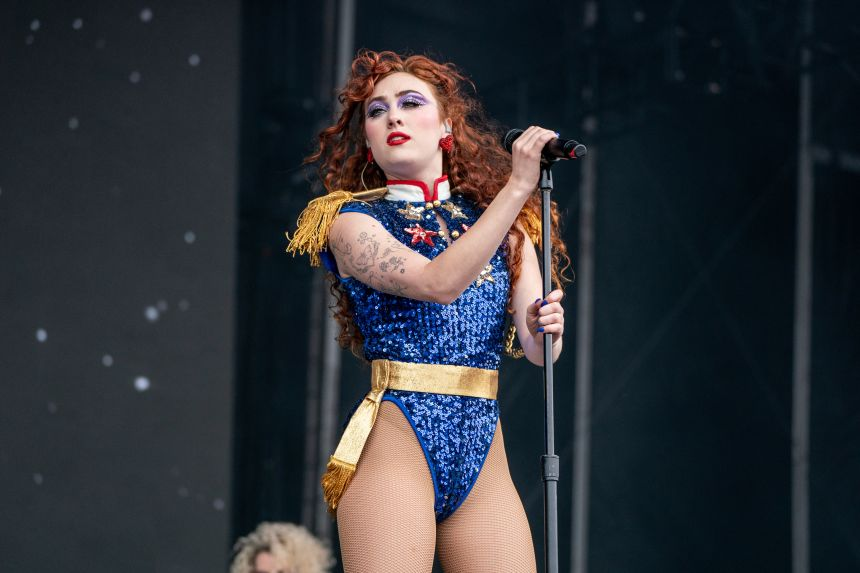
As a counter-example, Chappell Roan in 2024 said no to fan interactions, out loud, on main. "That's not normal, that's weird," she said of fans who felt entitled to photos and hugs and her time. The backlash was instant — people said she wasn't "cut out" for stardom, fame requires the "sacrifice" of privacy, she was biting the hand that feeds her.
Billboard ran a really good piece unpacking it and what we now expect from stars. It talks about how parasocial attachment is simply how humans are built — we form connections with familiar faces, and we always have, from gladiators to Beatlemania. That wanting is normal and ancient. What's broken at the moment is everything we've built (or failed to build) around it. Like platforms that make money from the illusion of intimacy, and the algorithms that turn two women outside a hotel into a global spectacle.
Fans aren't really the problem. Every time there’s one of these stories we all have to rush to say “we’re not like that”. The vast majority are as appalled by boundary-crossing as the artists are. The problem is that we keep treating proximity as something that will sort itself out. It won't. It needs structure. Which might be as simple as a barricade, or a paid ticket and a queue, or sometimes just an artist saying "no" and an industry backing her up. The famous people we love are also just people, walking out onto a dark street hoping we're going to be nice.
more good stuff
two weeks to go OMG(!) — we’ve announced Lume’s launch date and slate.
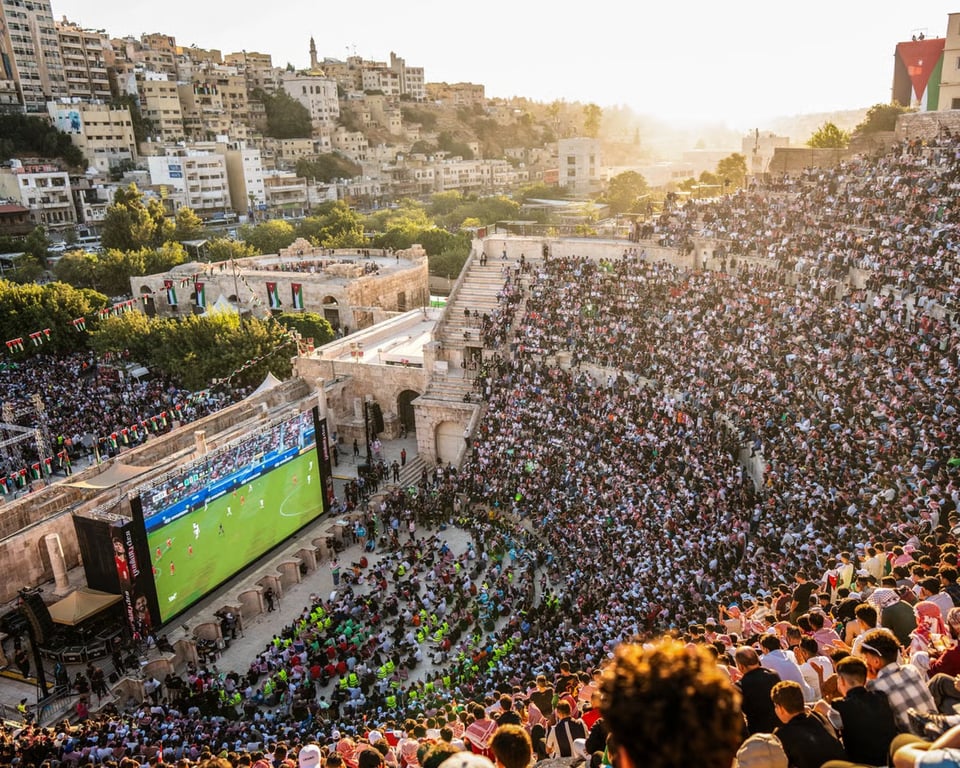
this is extremely cool, fans watching the World Cup in a 2000 year old Roman theatre.
last year I wrote about the Luddites in the context of genAI, so it was cool to see it in that context as NPR’s word of the week and learn more about the history.
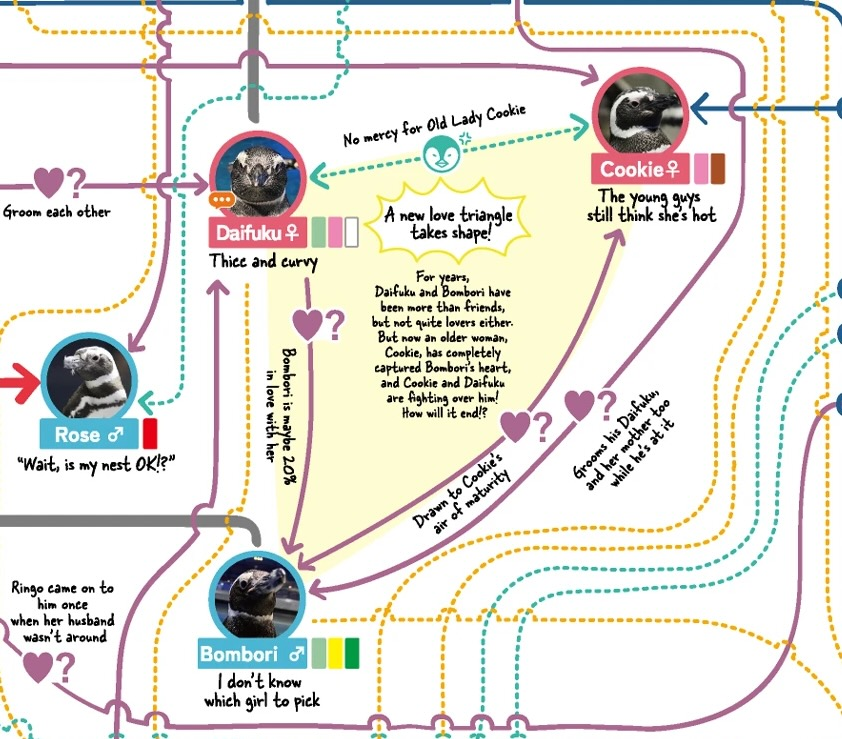
incredible chart from two Japanese aquariums tracking their penguins relationships. Close up:
finally, in my lego city

Forward this email to someone who thinks it’s beneath them.
You just read issue #81 of what you love matters. You can also browse the full archives of this newsletter.


Add a comment: