

I’ve spent this week in Sydney at Blackbird’s Sunrise conference again. This is the one I spoke at last year about the good internet. It’s always a glorious mix of attendees who have absolutely sold their soul to the boy-kings of silicon valley, and people who are doing genuinely cool shit, and this year was no exception.

As you’d expect, all anyone could talk about this year was AI. While one of the opening themes of the conference was “ambition”, the relentless focus on talking about how much faster everyone can code now felt anything but ambitious. It did help me clarify a lot of my current thinking about AI.
Before the welcome to Country, a guy behind me was explaining his startup to the person next to him. Apparently his “business” is a bunch of AI agents who create and launch “businesses” automatically without human intervention, in order to earn passive income. I immediately sent a message to our team slack saying “I want to die”. I like to reexamine my priors all the time, and listening to him still made me want to smash the looms.
He’s actually nothing new though. It’s the same motivation as the four hour work week guys, and the move-to-Bali-and-dropship guys and the manosphere sell-a-pdf-course guys. He’s just agentic now. Anyway, I assume eventually his agents will be selling “services” to other agents who buy them all without any humans knowing. I don’t think there’s any value creation there, but I also don’t care.
My favourite talk was from Jae Lubberink, who wielded beat poetry and a gen z slide deck to talk about all the ways in which AI is destroying creativity. You can read the gist of his talk here at his newsletter here (tw:substack).
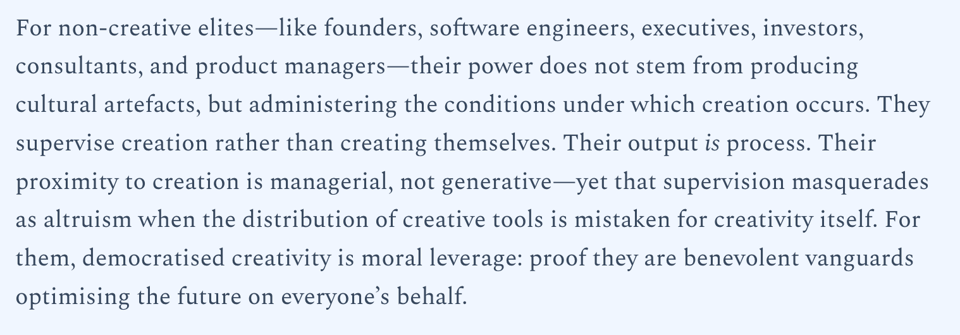
One of the things that was striking at the conference is that apparently we are all “builders” now. Because AI coding tools make it possible for non-technical people to prototype and to design and so on, the distinction between devs and the rest of the business is not so stark. You can flatten the audience. Sitting in Jae’s talk, I kept thinking about the flattening happening everywhere.

It made me think about last year when we were talking about the flattening aesthetic of the platform internet. Jae’s call to arms was that we all need to do the work to retain our creativity. That outsourcing it to the machines is just a drive to a very bland mean. Write the piece not the prompt.
Early on in the week, Karl and I were talking about the early days of the iphone app store, which resulted in a wave of independent development because it was possible to make a living from designing a cool app and selling it.
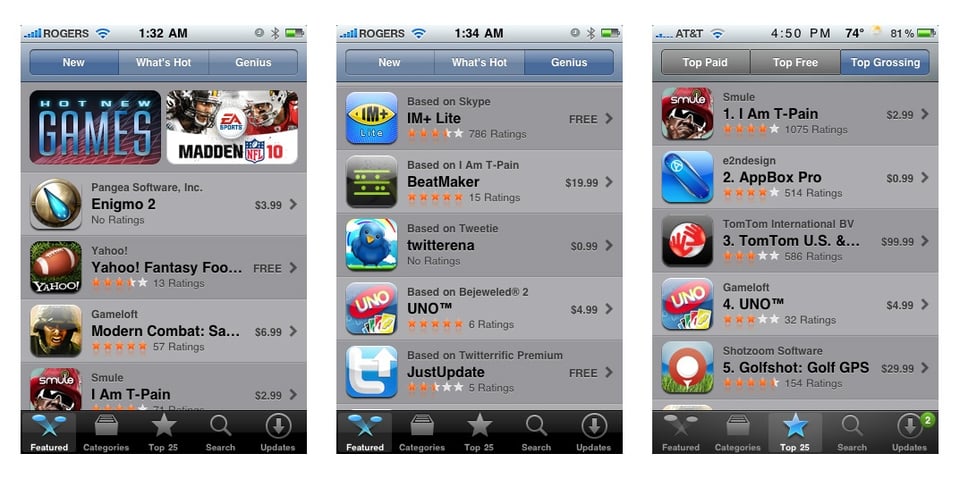
But over time, that became less and less possible. Every app has a hundred clones. Developers were offered extremely well-paid jobs to go and work for the man, and that category of independent devs sort of dried up (I’m generalising, don’t come for me independent devs).
Karl pondered whether, now that these coding tools are (a) undermining the case for companies to hire teams of well-paid developers meaning the jobs might be going away; and (b) making it possible for a single dev to spin up almost anything on their own, we might see a new wave of new things.
I think that’s what I find dispiriting about most of the current discussion about AI usage. First of all, outside of coding tools, people hate it.
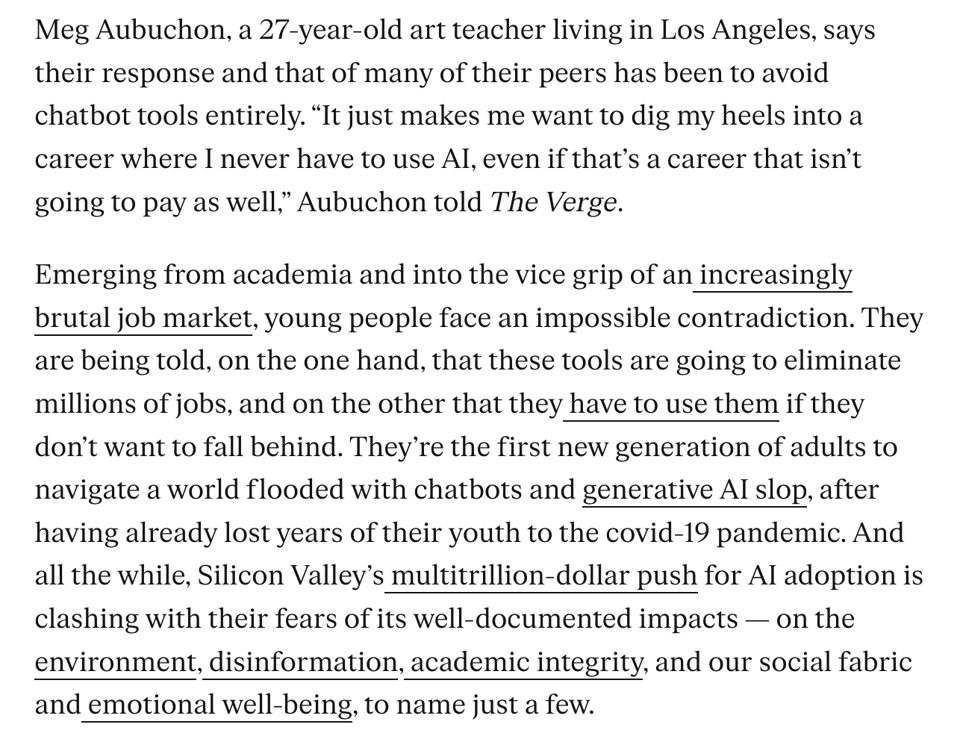
I’m constantly being told that we all need to focus, as individuals and as nations on not getting “left behind” in the AI race. And it makes zero sense. Wtf is the race? If the tools are good they’ll be under the hood of the services I use and I won’t notice — that might be an improvement on my current practice of yelling AGENT at every customer service chatbot I encounter.
Second, noone seems to be grappling with the fact that the AI subsidisation era is coming to an end. The speakers from Anthropic alluded to it obliquely, suggesting to the room that businesses should move to usage-based pricing if they want to retain their margins. AI tools are about to become very expensive. This week an Nvidia VP said that AI compute was costing more than human labour (the irony). So a lot of these hackathon-style business ideas become nothing-burgers.
Third, even when we’re concentrating on the one area where AI tooling is very good (coding), everyone seems to be focussed on automating workflows instead of what else might be possible. Talking to founder after founder whose business was some variant on “we use AI to make it easier to do x” just felt so shortsighted. And then what?
Earlier in the week, I went to see Mike Hewson’s The Key’s Under the Mat at the Art Gallery of NSW. It turns out that four stories under the gallery is a giant concrete tank that used to hold oil, that has been cleaned out and made into an exhibition space. It reminded me a bit of those big industrial spaces on the right in the Tate Modern.
Hewson has turned the space into a massive community park, entirely underground. It felt like something straight out of post-apocalyptic fiction. This is what a park is like in Silo.
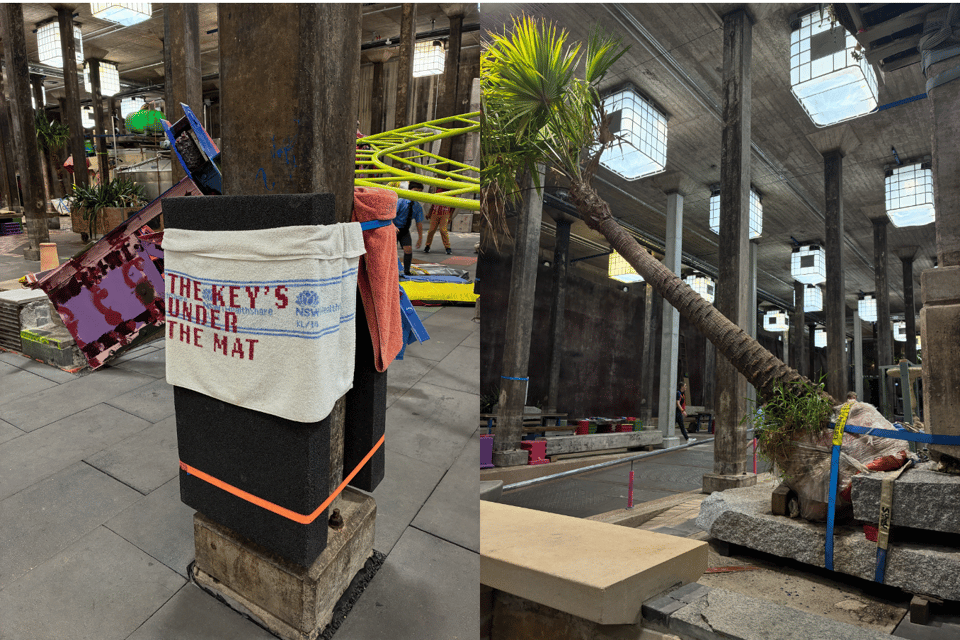
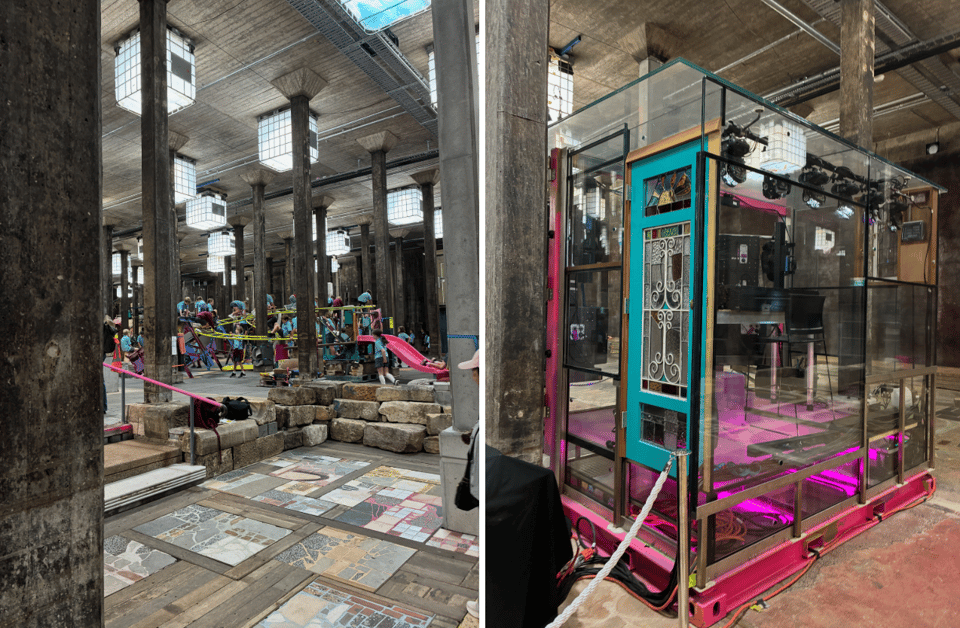
Not everyone gets the chance to make art in a giant bunker. But I’d love it if the conversations we were having about AI got to be about what weird and wonderful and human and creative things the software development tooling might make it possible for us to bring into existence. “Automating tax payments” and “building business dashboards” and “outsourcing your relationship with your kid” is just so limited and depressing.
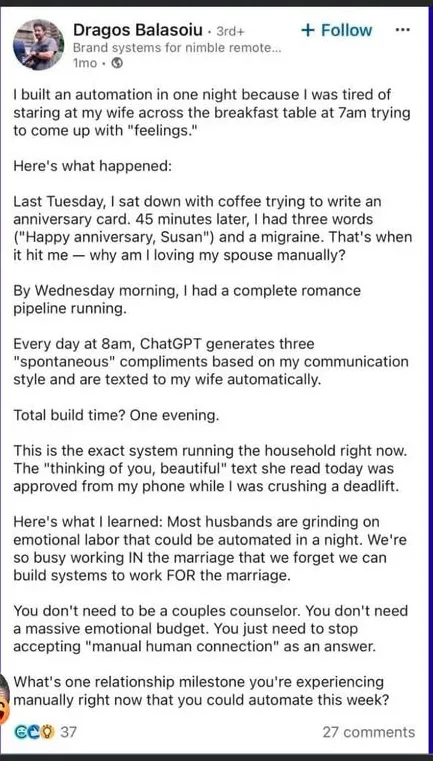
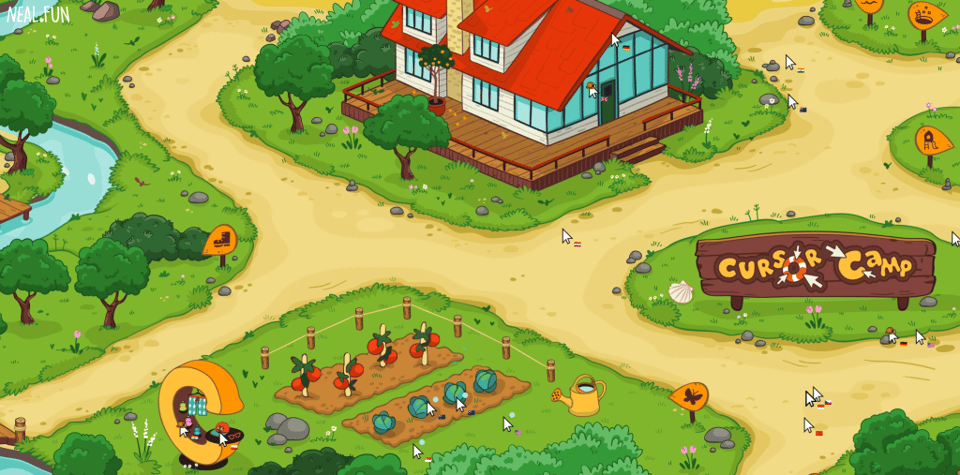
I don’t want the robots to be creative for me. They’re terrible at it. And maybe the economic and environmental and human cost of the tooling is so high once we’re all aware of it (when the fog of vc subsidisation clears) that what we’ll wind up with is bespoke, local models that do a particular thing we care about well, who knows. But if, when the dust settles, the tools make it possible for more of us to birth train jazz, or cursor camps, then the digital world might be a nicer place to be.
more good stuff
the wonderful Fansplaining has relaunched as an independent, subscriber-supported publication. One longread a week: reporting, analysis, criticism, and much more, all by, for, and about fandom. Love this for all of us at a time when writing about fandom is SO annoying in most mainstream pubs. The launch feature is about The Pitt.
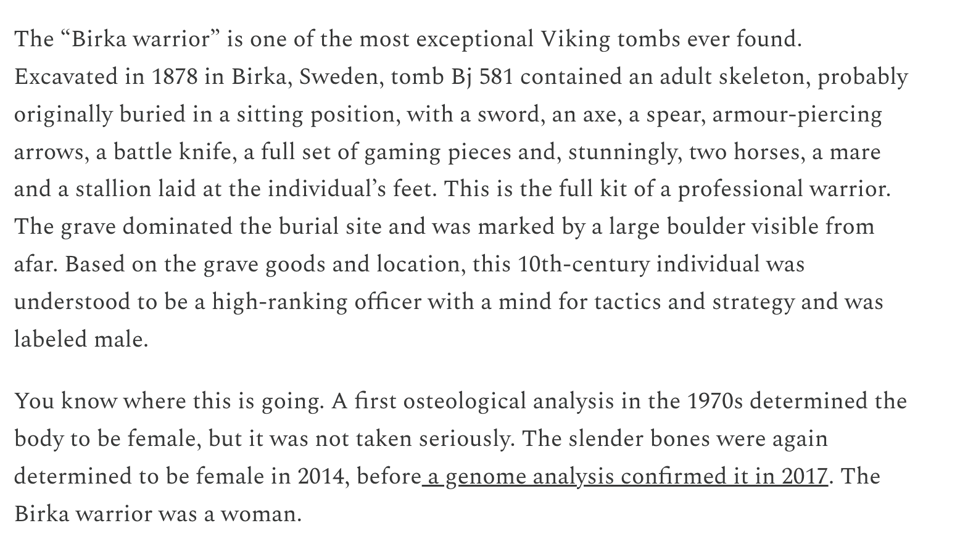
on women and rage and music, Thank god for the angry women in my headphones.

finally, in my lego city

Forward this to someone who has never heard of agentic AI and is happy about that.
You just read issue #72 of what you love matters. You can also browse the full archives of this newsletter.


Add a comment: